Shock wave–boundary layer interactions on re-entry vehicles and missiles: separation, heating and skin friction at hypersonic speeds.
SWBLI
Double wedge & double cone
GPU wake simulations
Overview
Hypersonic shock wave–boundary layer interactions (SWBLI) are a crucial aspect of aerospace engineering, particularly in the design and analysis of high-speed vehicles such as re-entry spacecraft and missiles. These interactions occur when a shock wave, generated by the vehicle travelling at hypersonic speed, impinges on the boundary layer that develops along the vehicle’s surface.
The interaction can lead to complex flow phenomena, including boundary layer separation, increased heat transfer and higher skin friction, which can significantly affect vehicle stability and thermal loading. Accurate modelling of SWBLI is essential for predicting these effects and ensuring the structural integrity and performance of hypersonic vehicles. Computational fluid dynamics (CFD) simulations, supported by wind tunnel experiments and advanced turbulence models, play a pivotal role in understanding and mitigating adverse SWBLI effects, enabling safer and more efficient vehicle designs.
HAVA-HYPERFDX1
HAVA-HYPERFDX1 is the laboratory’s in-house, high-fidelity GPU-accelerated solver for hypersonic flows with strong shocks, separated regions and high-temperature gas effects. It is designed for detailed studies of canonical and vehicle-relevant configurations, including shock wave–boundary layer interactions and compression-corner flows, where accurate resolution of gradients, surface loading and unsteady structures is essential. Its simulations and verification cases are on the HAVA-HYPERFDX1 page.
Results
▶
Hypersonic flowsSimulation
Shock wave–boundary layer interaction on a 5/30° double wedge
Three-dimensional Mach 7 flow over a double wedge at 781 Pa, showing spanwise velocity, numerical schlieren and surface heating.
Mach 7SWBLI3-D
Hypersonic flowsSimulation
Shock wave–boundary layer interaction on a 5/30° double wedge
Spatial distribution of the spanwise velocity W (m/s) on three x-constant planes, (a) x = 0.04 m, (b) x = 0.064 m and (c) x = 0.08 m, together with (d) the numerical schlieren in grayscale and the surface heat flux (W/m²) along the wedge surface, for a unit Reynolds number of 4.14 × 10⁵ 1/m (P∞ = 781 Pa) over the 5/30° double-wedge configuration.
Mach 7 flow over the 5/30° double wedge, P∞ = 781 Pa.
Hypersonic flowsSimulation
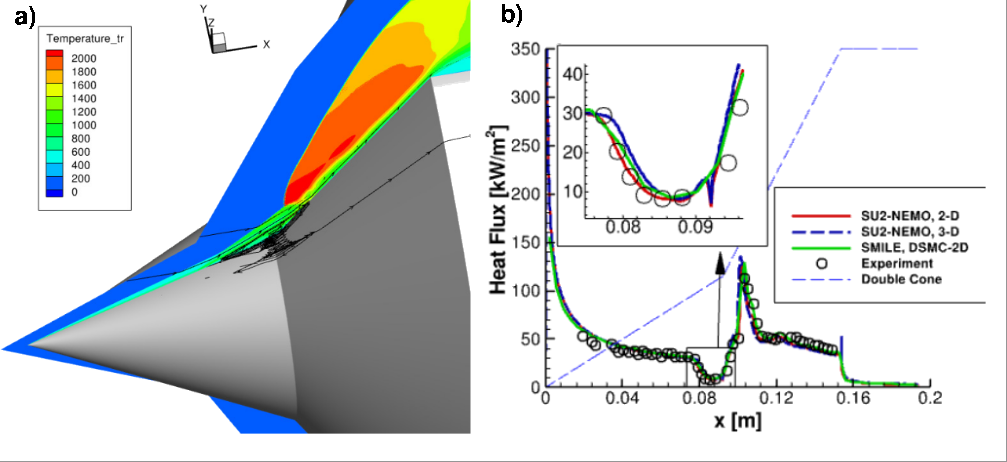
Double cone in 2-D and 3-D
Translational temperature and surface heating from continuum SU2-NEMO 2-D and 3-D solutions at the lowest pressure.
Comparison of the surface parameters for a unit Reynolds number of 9.35 × 10⁴ 1/m: (a) spatial distribution of the translational temperature and (b) surface heating (kW/m²) from the continuum SU2-NEMO 2-D and 3-D solutions for the lowest-pressure case.
Translational temperature and surface heating, SU2-NEMO 2-D and 3-D.
HAVA-HYPERFDX1 is the laboratory's in-house, high-fidelity GPU solver for hypersonic flows with strong shocks, separated regions and high-temperature gas effects. This wake simulation used about 0.3 billion grid points on a $3K desktop and finished in less than 15 hours, not on a large HPC cluster with thousands of nodes. More results are on the HAVA-HYPERFDX1 page.
Hypersonic cylinder wake computed with HAVA-HYPERFDX1.