Kinetic DSMC solver for rarefied and nonequilibrium flows: hypersonic vehicles, spacecraft plumes, high-altitude aerothermodynamics and gas–surface interaction.
50–100× faster than CPU DSMC
Continuum to free-molecular
Runtime visualization
Overview
HAVA-DSMCX1 is an in-house, GPU-accelerated direct simulation Monte Carlo (DSMC) solver developed by the PI for rarefied gas dynamics and nonequilibrium flows. DSMC is a widely used method for solving the Boltzmann transport equation where continuum assumptions break down, including hypersonic flows, spacecraft plumes, high-altitude aerothermodynamics, vacuum expansions and plume–surface interactions.
HAVA-DSMCX1 is designed for modern GPU architectures, enabling large simulations that would otherwise need substantial CPU resources. Highly optimized particle-movement, collision and sampling algorithms give speedups above 50–100× over traditional CPU-based DSMC implementations, depending on the problem and hardware.
The software supports steady and time-accurate three-dimensional flows with complex geometries, moving boundaries, gas–surface interactions and multi-species mixtures in thermal nonequilibrium. Particle weighting and adaptive sampling allow efficient simulations across Knudsen numbers from continuum to free-molecular flow.
GPU-based rendering and rasterization let flow-field quantities be visualized during the run, removing expensive post-processing for simulations with hundreds of millions of particles.
Physical models
Collision cross sections use the Variable Hard Sphere (VHS) and Variable Soft Sphere (VSS) models. Energy exchange between translational and internal modes uses the Larsen–Borgnakke approach, with internal energy relaxation rates from the Millikan–White and Parker models.
Ongoing work
The solver is the kinetic component of the HAVA multi-fidelity framework and is being integrated with GPU-accelerated Navier–Stokes and hybrid continuum–kinetic solvers. Ongoing developments include gas-phase chemistry, gas–surface reactions, particle-laden flows, plasma and electromagnetic effects, and machine-learning-assisted acceleration for next-generation hypersonic and space applications.
Simulations & verification
▶
DSMCX1Simulation
Moving rarefied flow at Mach 12
Complex moving rarefied-flow structures at Mach 12 resolved on a desktop workstation with an RTX 4090.
HAVA-DSMCX1 resolving complex moving rarefied-flow structures at Mach 12. The simulation runs on a desktop workstation with an NVIDIA RTX 4090, capturing detailed flow physics at a fraction of the cost of conventional CPU-based DSMC implementations.
Mach 12 rarefied flow computed with HAVA-DSMCX1.
2 figures
DSMCX1Verification
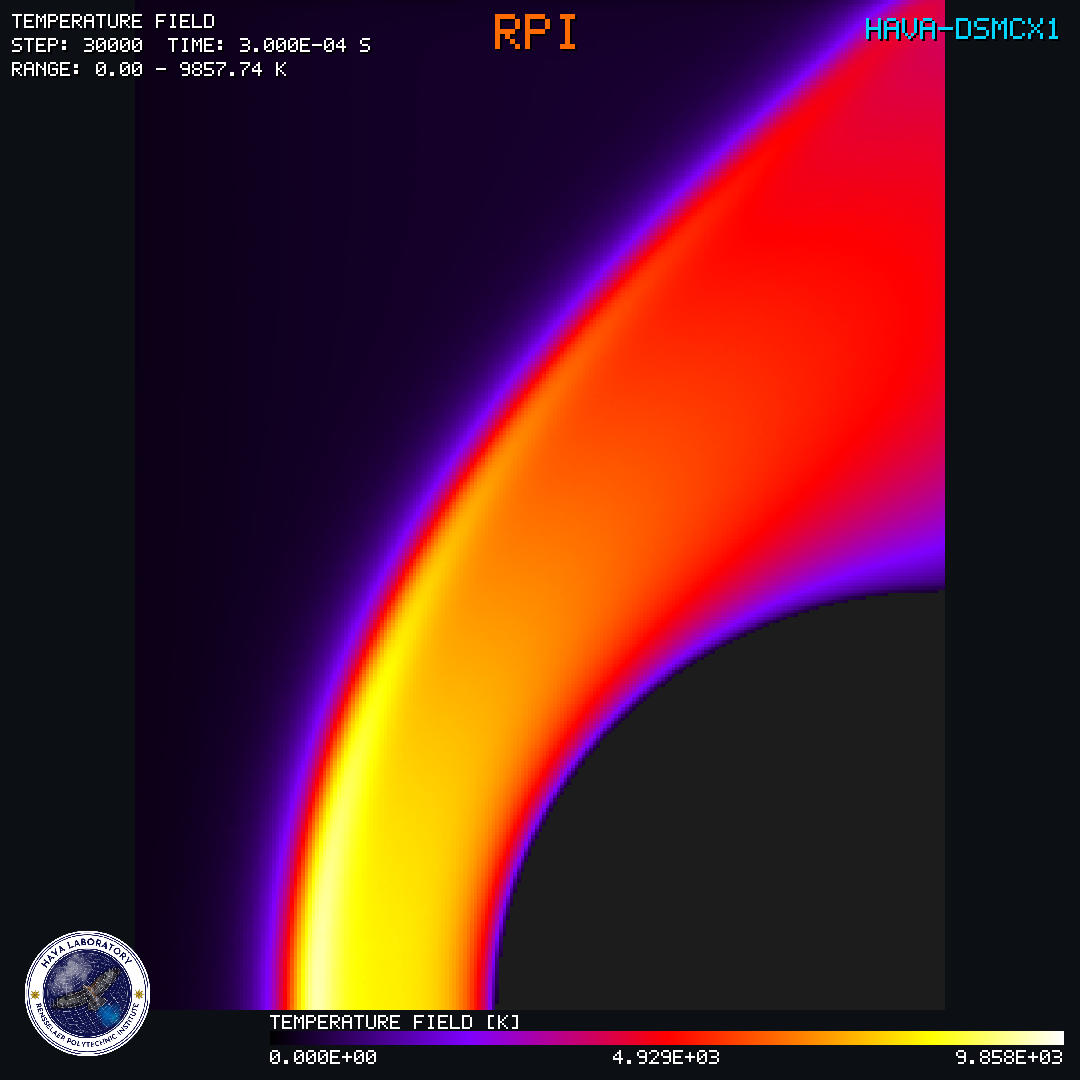
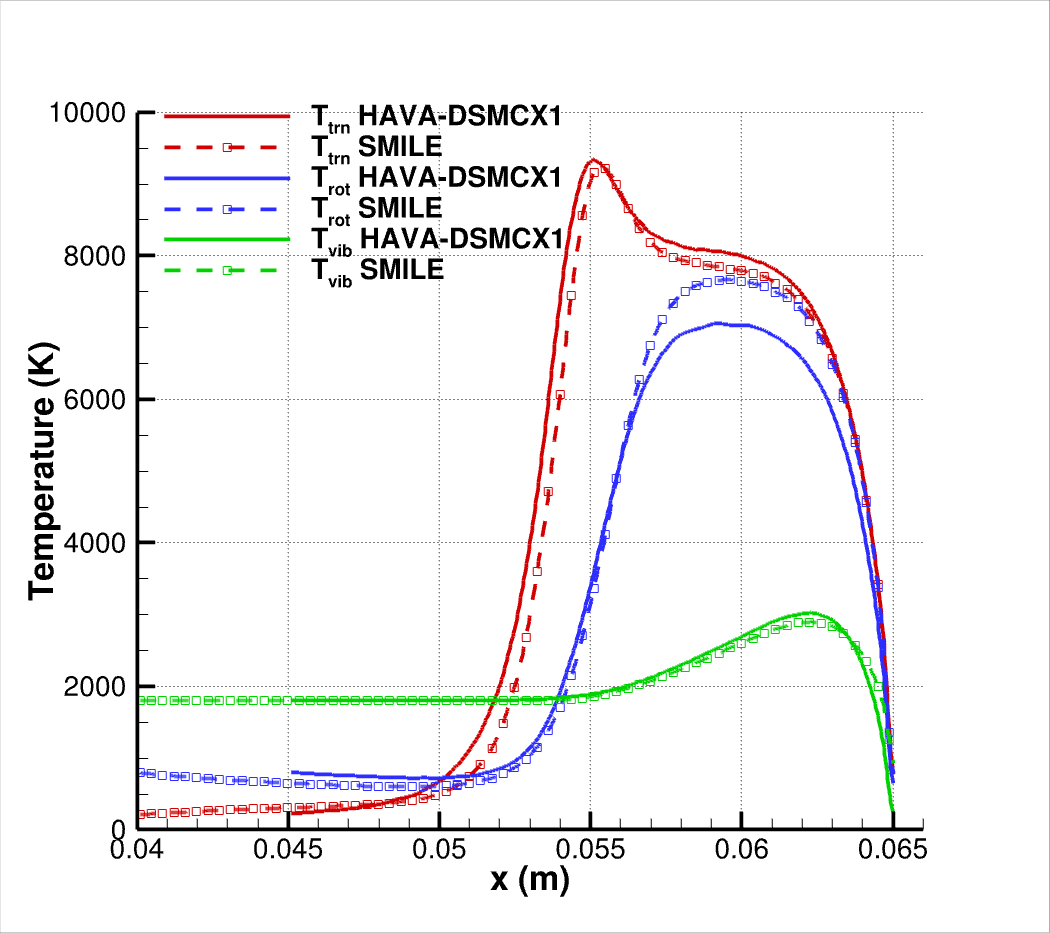
Cylinder in thermal nonequilibrium against SMILE
Flow structure and stagnation-line profiles agree closely with the established SMILE DSMC solver.
Collision cross sections use the Variable Hard Sphere (VHS) and Variable Soft Sphere (VSS) models, and energy exchange between translational and internal modes uses the Larsen–Borgnakke approach, with relaxation rates from the Millikan–White and Parker models. The results are compared with the SMILE DSMC solver developed by the groups of Mikhail Ivanov and Sergey Gimelshein, and the two codes agree closely for this cylinder in thermal nonequilibrium.
Temperature field around the cylinder.Profiles along the stagnation line, HAVA-DSMCX1 against SMILE.
DSMCX1Verification
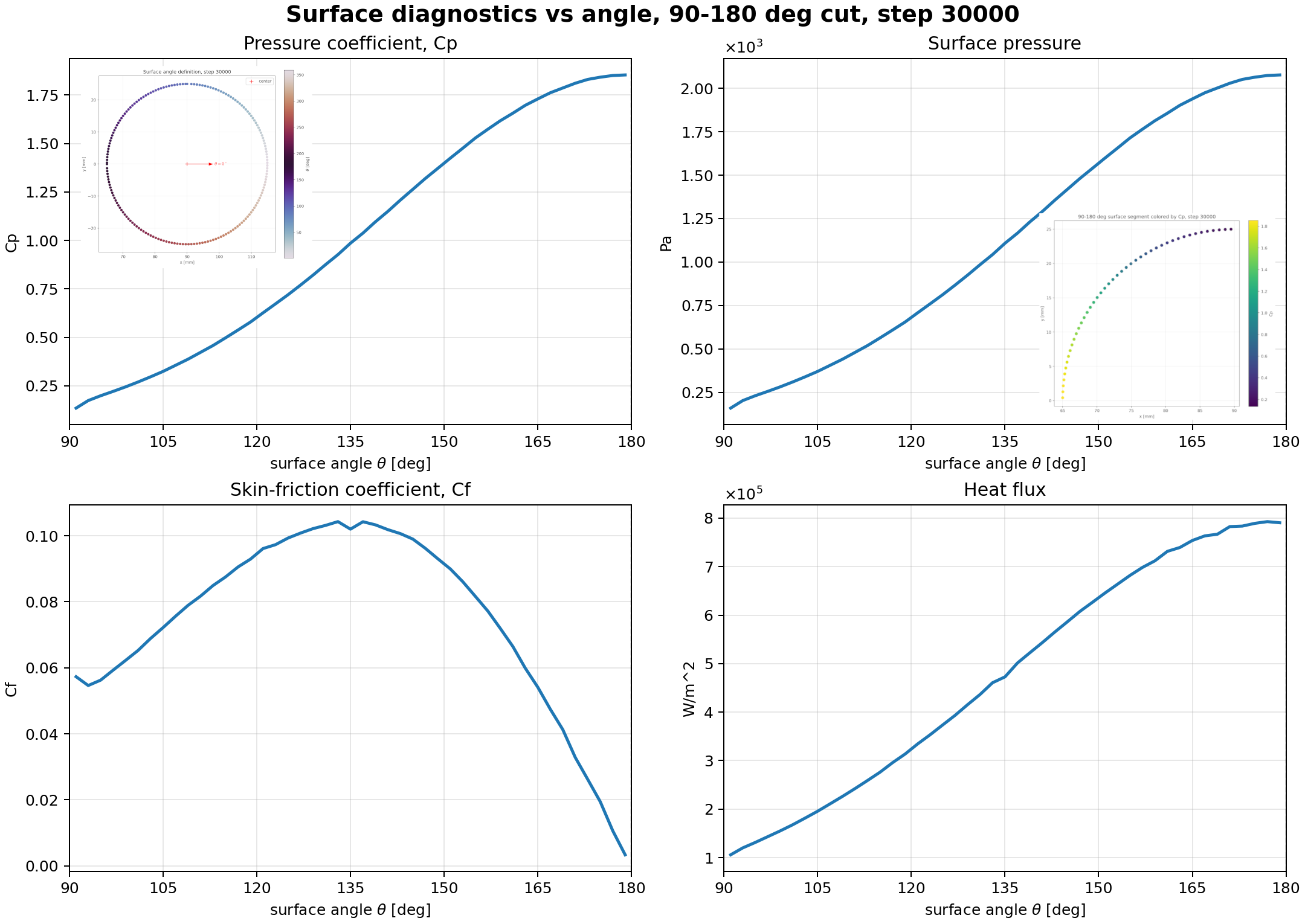
Surface properties at 4 km/s and 68 km altitude
Heat flux, surface pressure, velocity slip and temperature jump for a 4 km/s free stream at 68 km.
HAVA-DSMCX1 predicts a wide range of surface properties, including heat flux, surface pressure, velocity slip and temperature jump. The graphs show these quantities for a free-stream velocity of 4 km/s at an altitude of 68 km.
Surface parameters for a 4 km/s free stream at 68 km.