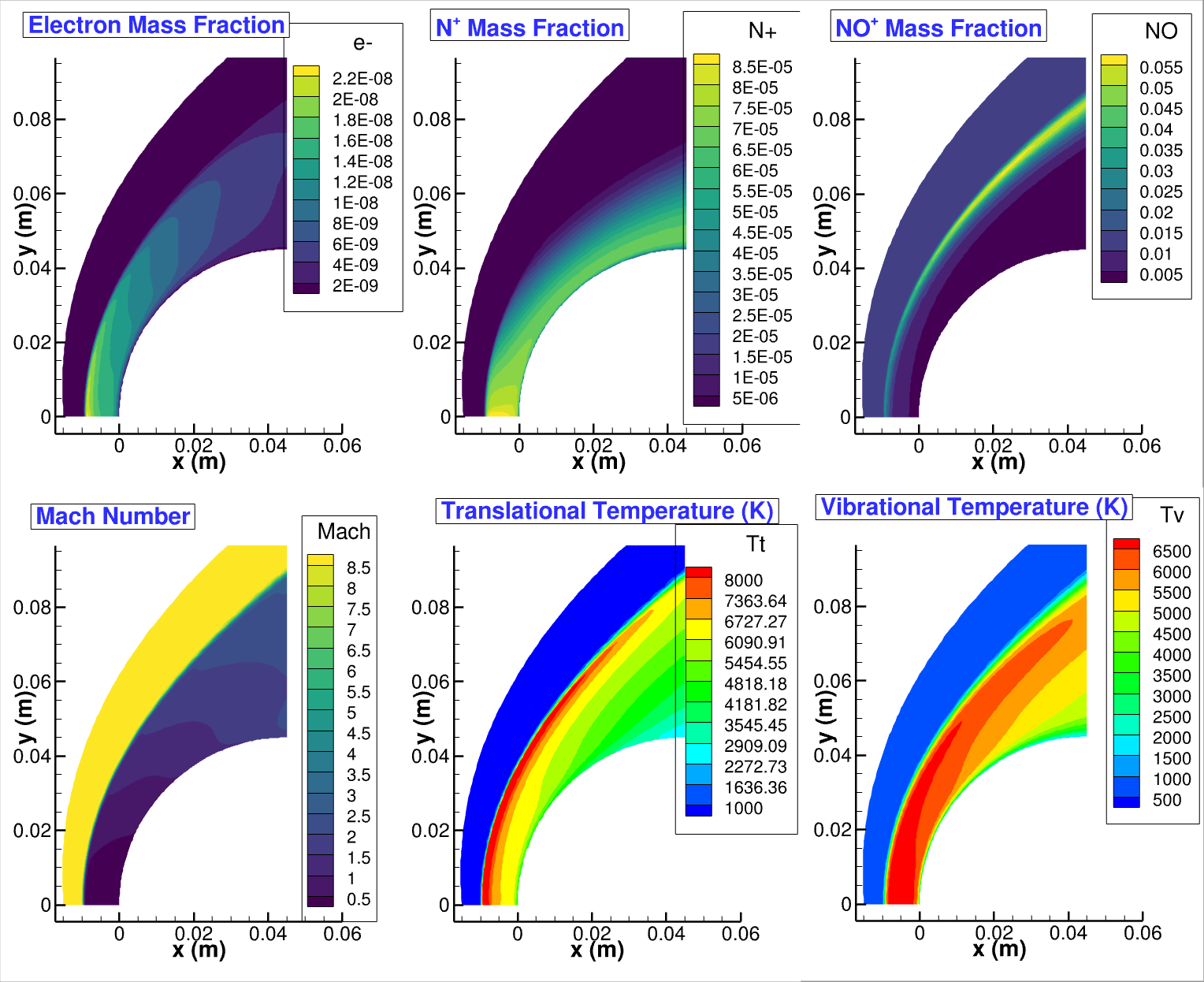
How intense hypersonic heating dissociates air and drives chemical reactions, and what this means for heat transfer, materials and propulsion.
Dissociation
Real-gas effects
High-fidelity chemistry
Overview
Chemically reacting flow in hypersonic environments concerns how high-speed airflow influences and modifies chemical reactions within a fluid. At hypersonic velocities, commonly above five times the speed of sound, intense compression and friction heat the surrounding air, causing dramatic temperature increases. This severe heating dissociates molecules and starts a range of chemical reactions in the air.
Understanding these processes is essential for engineering materials and propulsion systems that can endure the conditions of hypersonic flight. These investigations are crucial for predicting heat transfer rates, assessing material degradation and evaluating the performance of hypersonic vehicles, driving advances in aerospace technologies designed for extreme speeds. Our team integrates high-fidelity chemistry data into in-house and open-source solvers to benchmark the effects of real gases accurately.
Results
Reacting flowsSimulation
Real-gas chemistry in hypersonic flow
High-fidelity chemistry data built into our in-house and open-source solvers to benchmark real-gas effects.
At hypersonic speeds, compression and friction heat the air strongly enough to dissociate molecules and start a range of chemical reactions. Our team integrates high-fidelity chemistry data into in-house and open-source solvers to benchmark these real-gas effects accurately.