Kinetic DSMC solutions of the Boltzmann equation and continuum Navier–Stokes models for rarefied, low-density hypersonic flows.
DSMC
Boltzmann equation
DSMC vs Navier–Stokes
Overview
The DSMC method
Direct simulation Monte Carlo (DSMC) [Bird] is a kinetic approach that provides a numerical approximation to the solution of the Boltzmann transport equation,
where \(f(c_i)\) and \(n\) are the distribution function of class \(c_i\) and the number density. The external force field acting on gas molecules, \(F_j\), is generally assumed to be zero for gas flows. DSMC decouples collisions from particle motion by keeping the time step smaller than the mean collision time, so that particles do not cross several cells in one time step.
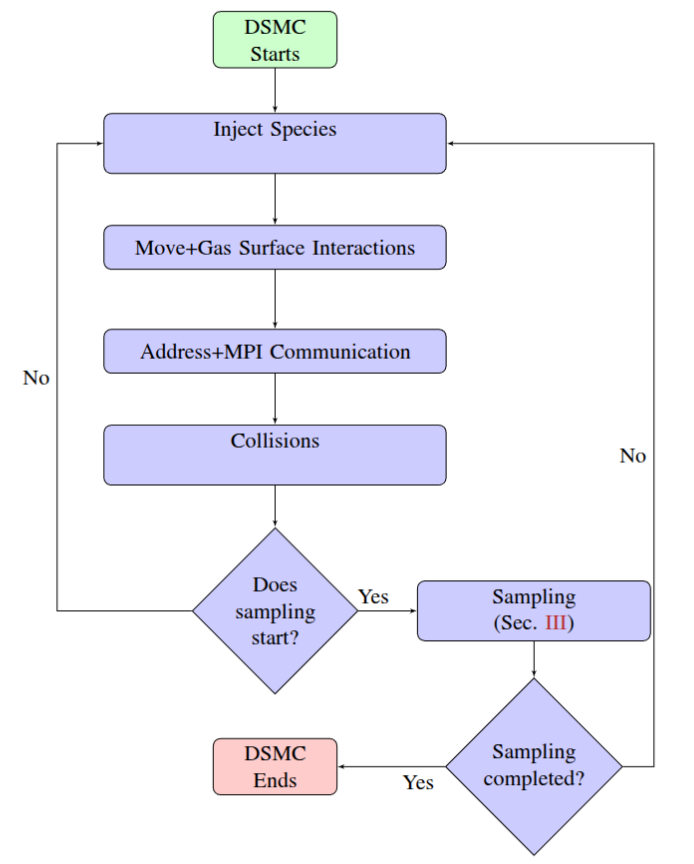
As shown in the figure, the Boltzmann equation is solved stochastically: (1) particle states are initialized and computational particles are introduced at the inflow boundaries, (2) the particles are moved, (3) collisions are performed stochastically within collision cells, and (4) particle quantities are sampled to evaluate macroscopic properties. Newtonian mechanics is used for particle movement, gas–surface interactions and boundary conditions. Modelling collisions is crucial, since they determine the transport properties: thermal conductivity, diffusion and viscosity. DSMC is a very efficient and robust approach, especially for high-Knudsen-number flows.
The DSMC algorithm.
Turbulent rarefied wakes
Our group carries out both kinetic and continuum simulations with open-source and in-house software to investigate the turbulent nature of rarefied hypersonic wakes over a wide range of flows. In this test case we focused on hypersonic flow over a cylinder to examine the unsteady behaviour of rarefied and continuum turbulent wakes. SPARTA, an open-source DSMC solver, was used to capture the large gradients of the shock–expansion wave interactions, particularly in the wake. Continuum simulations were performed with SU2-NEMO, an open-source nonequilibrium solver, for relatively low free-stream pressures of up to 100 Pa, characteristic of rarefied conditions.
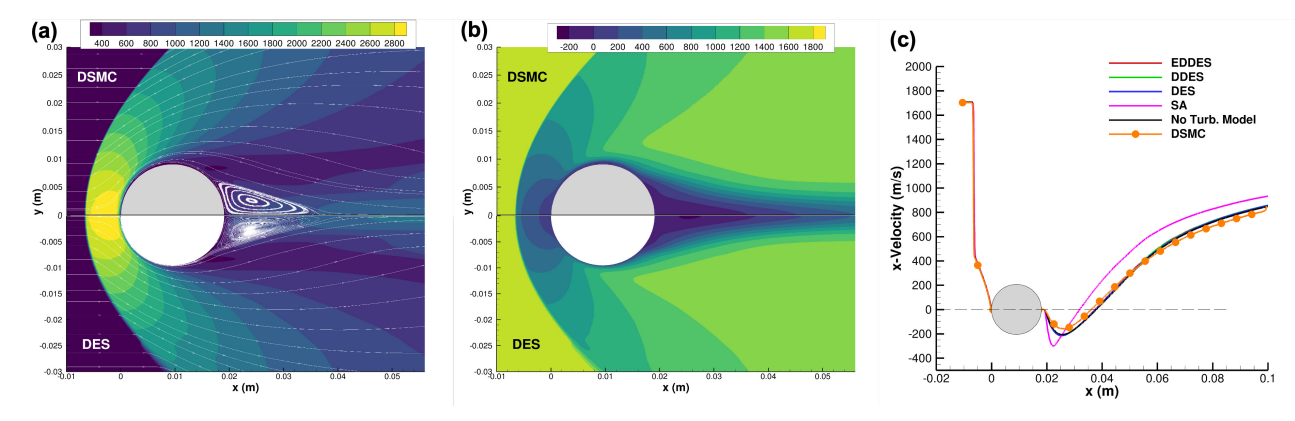
The translational temperatures predicted by the Navier–Stokes (NS) equations with the detached-eddy simulation (DES) turbulence model and by direct simulation Monte Carlo (DSMC) agree very well, and the axial velocity profiles of DSMC closely match those of NS. For a more detailed comparison, the axial velocities from NS with different turbulence models, including the Spalart–Allmaras (SA) model and the hybrid LES–RANS models (DES and delayed DES, DDES), are compared along the stagnation line. The agreement between NS and DSMC is particularly strong in the recirculation region, where the axial velocity drops below zero.
Turbulent fluctuations in these simulations are not strong enough to affect the mean flow significantly, which explains the nearly perfect agreement between NS without a turbulence model and DSMC. Benchmarking turbulence models against DSMC at relatively low Reynolds numbers nevertheless gives valuable insight into the origins of macroscopic fluctuations and the accuracy of these models in low-density hypersonic flows. The discrepancy between the SA model and DSMC is not unexpected, given the limitations of SA for high-speed separated flows. Further details are in the paper.
Results
Rarefied flowsVerification
Rarefied cylinder wake, DSMC against Navier–Stokes
SPARTA DSMC and SU2-NEMO Navier–Stokes solutions for argon at Mach 7 and 100 Pa agree closely, also in the recirculation region.
SPARTASU2-NEMOturbulence models
Rarefied flowsVerification
Rarefied cylinder wake, DSMC against Navier–Stokes
Comparison of DSMC (SPARTA) and Navier–Stokes solutions for argon at a free-stream pressure of 100 Pa and Mach 7: (a) temperature field (K), (b) axial velocity (m/s), and (c) axial velocity along the stagnation line with several Navier–Stokes turbulence models in SU2. See the paper for details.
DSMC (SPARTA) against Navier–Stokes (SU2), argon, 100 Pa, Mach 7.